
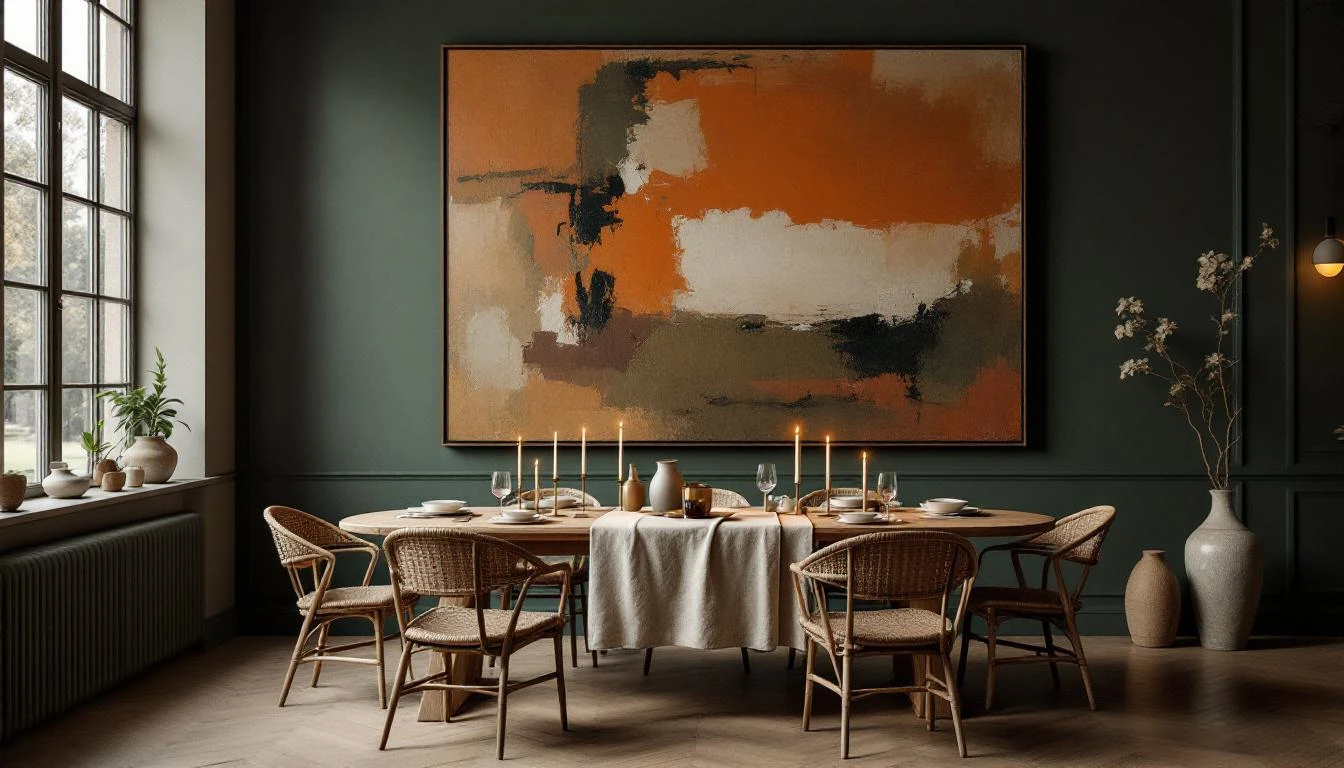
Last week I stayed at a friend's table until nearly midnight. Six people, a roasted chicken, one bottle of wine too many, and above us on the wall hung a large abstract painting in deep terracotta and olive green. Nobody consciously looked at it all evening — but everyone felt it belonged. That, I think, is exactly what 2026 is about: the quiet return of the dining room.
Why the Dining Room Is Becoming a Room Again
For years, dining was something you folded into the kitchen. Open plan, efficient, fast. In 2026 I see magazines from Livingetc to Homes & Gardens tracing the same arc: people are reclaiming the dining room as a separate space. Not to be formal, but to be allowed to slow down. Candles lit, a linen runner across the table, the "good" plates pulled out on a random Tuesday. It's the quiet revolution of the long dinner — and the room is asking for more than just a table and six chairs.
Colour as the First Course
The palette for 2026 reads like a sensory menu. Deep forest green, ochre, terracotta, russet red, cobalt blended with warm yellow. These shades don't shout — they wrap. They turn a table into a place where people want to stay, where one more conversation unfurls before anyone thinks about getting up. Designers are pairing them with continuous wall treatments — limewash, grasscloth, hand-troweled plaster — to give the room the feeling of a cocoon.
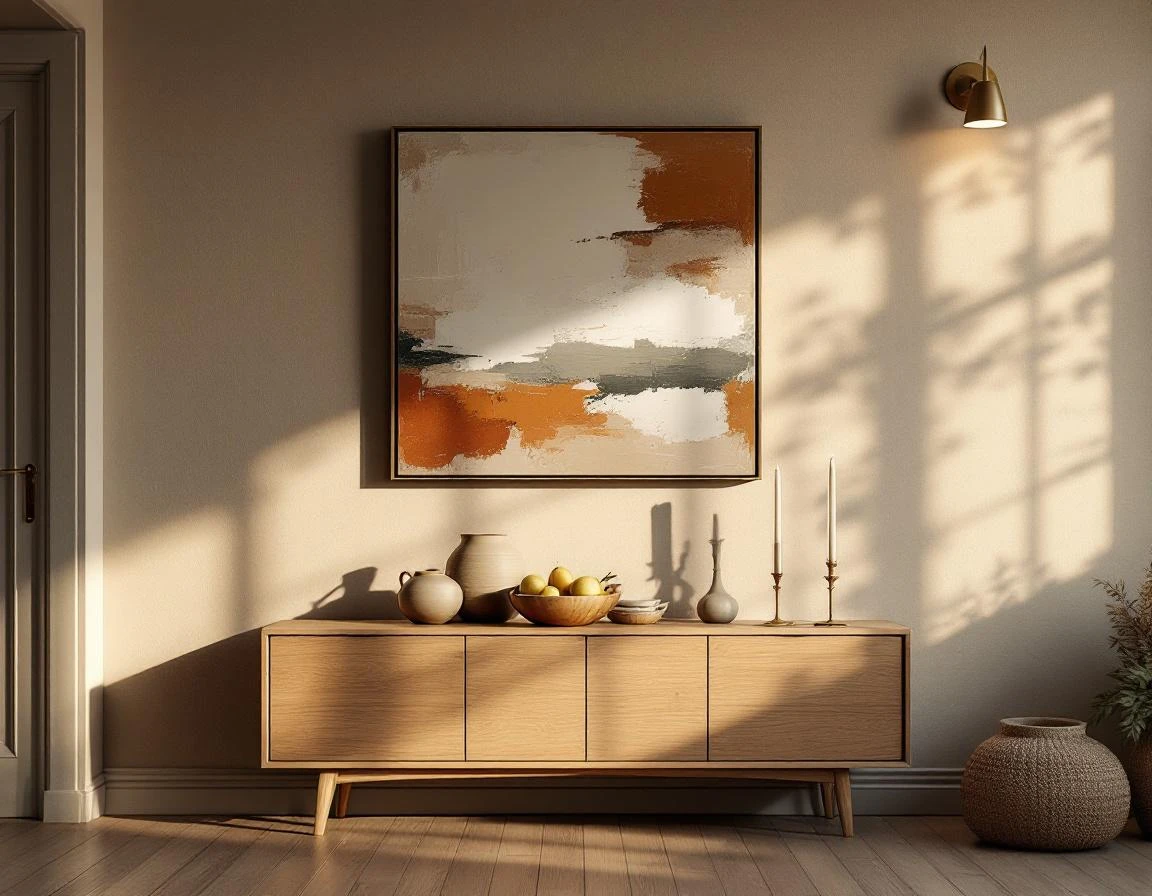
Art as the Host of the Evening
This is where the painting comes in. Above a dining table, art plays a different role than it does elsewhere in the home. You aren't looking at it the way you look at a piece above the sofa — you're sitting under it, eating under it, talking under it. So it can be substantial without being loud. A textural abstract with visible brushwork and warm earthy tones adds the exact depth that 2026's biggest dining trend — mood-driven design — is asking for. The work responds to candlelight, shifts with the seasons, and quietly becomes the host of the evening.
Scale and Placement, Made Simple
Here's the rule I share most often: your artwork should be about two-thirds to three-quarters the width of your dining table. A two-metre table calls for a painting around 140 to 160 centimetres wide. Hang it low — the centre roughly 150 cm from the floor, with around 15 to 25 cm of breathing space above the pendant or the tabletop. Hang it higher and the piece floats, disconnected from the table. Get it right, and it belongs.
Choose by Feeling, Not by Swatch
The biggest shift in 2026 is this: people are no longer choosing art to match the tablecloth. They choose on feeling. Do you want your dining room to wrap you in warmth for long winter evenings? Lean into earthy tones — ochre, soft browns, terracotta. Do you want energy for summer dinners with the garden door open? Reach for something more alive — a stroke of coral, a ribbon of cobalt. The painting sets the tone for every meal that happens beneath it.
Ready for the Long Dinner?
A dining room without the right piece of art is a bit like a table without candles. It works — but something is missing. If you want to explore which painting could turn your dining room into a host, browse the collection at DNH Artful Living or reach out for a personal conversation. We'll look at your space, your light, and the mood you want to bring to your table.