
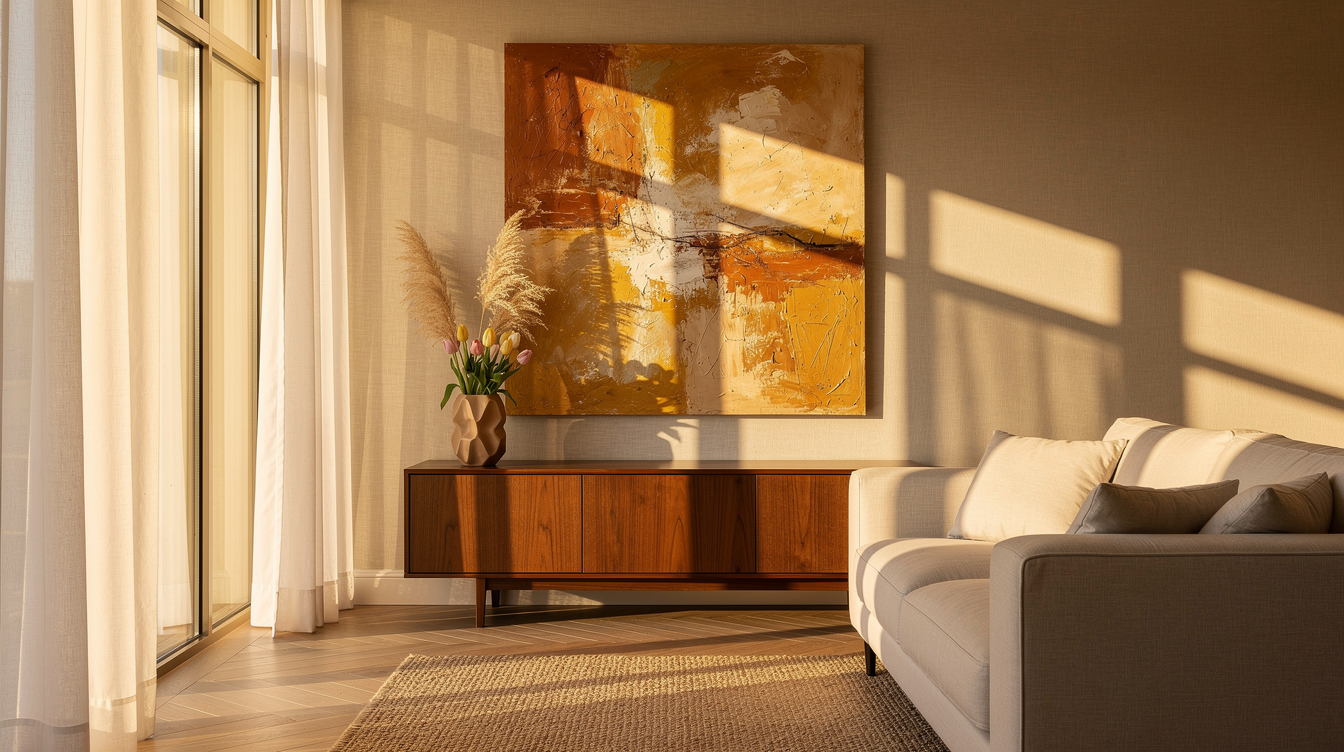
The other morning I walked into my studio just after sunrise. The light fell at a low angle across a canvas I had finished the night before, and I barely recognised my own work. Colours that had looked deep and moody under the studio lamp were suddenly bright, almost playful. It was a reminder I never get tired of: light doesn't just reveal art — it reshapes it.
Why Light Transforms Your Art
Every painting lives two lives: one in daylight, one in artificial light. Daylight carries the full colour spectrum, so pigments show their most nuanced side — subtle undertones, delicate transitions between layers. Artificial light, depending on its colour temperature, amplifies certain tones while suppressing others. An abstract piece in warm earth tones that feels calm during the day can turn intense and dramatic under a warm spotlight at night.
Spring makes this shift impossible to ignore. The days stretch longer, sunlight reaches deeper into your rooms, and your art literally changes with the season. That's not a flaw — it's a feature.
Daylight as a Creative Partner
The best spot for a painting isn't necessarily above the sofa. It's wherever the light finds it. A canvas next to a window — not in direct sunlight, but in that soft, reflected glow — takes on an almost ethereal quality. Brushstroke textures become visible, colour layers gain a depth you simply can't see under flat overhead lighting.
Spring light is particularly special. It's softer than summer light, less flat than winter light. It shifts throughout the day in a way that makes abstract work feel alive — shadows move, hues shift. Interior designers call this 'dynamic living': your space evolves without you lifting a finger.
Here's a tip I always share: walk through your home at different times of day and notice where the light falls. That spot at ten in the morning with the beautiful slanting rays? That's where your favourite piece deserves to hang.
The Art of Good Art Lighting
When the sun goes down, you take over. And this is where many homes fall short. A bright ceiling fixture washes all the nuance out of a painting — it goes flat, loses its magic. The fix is more targeted than you might think.
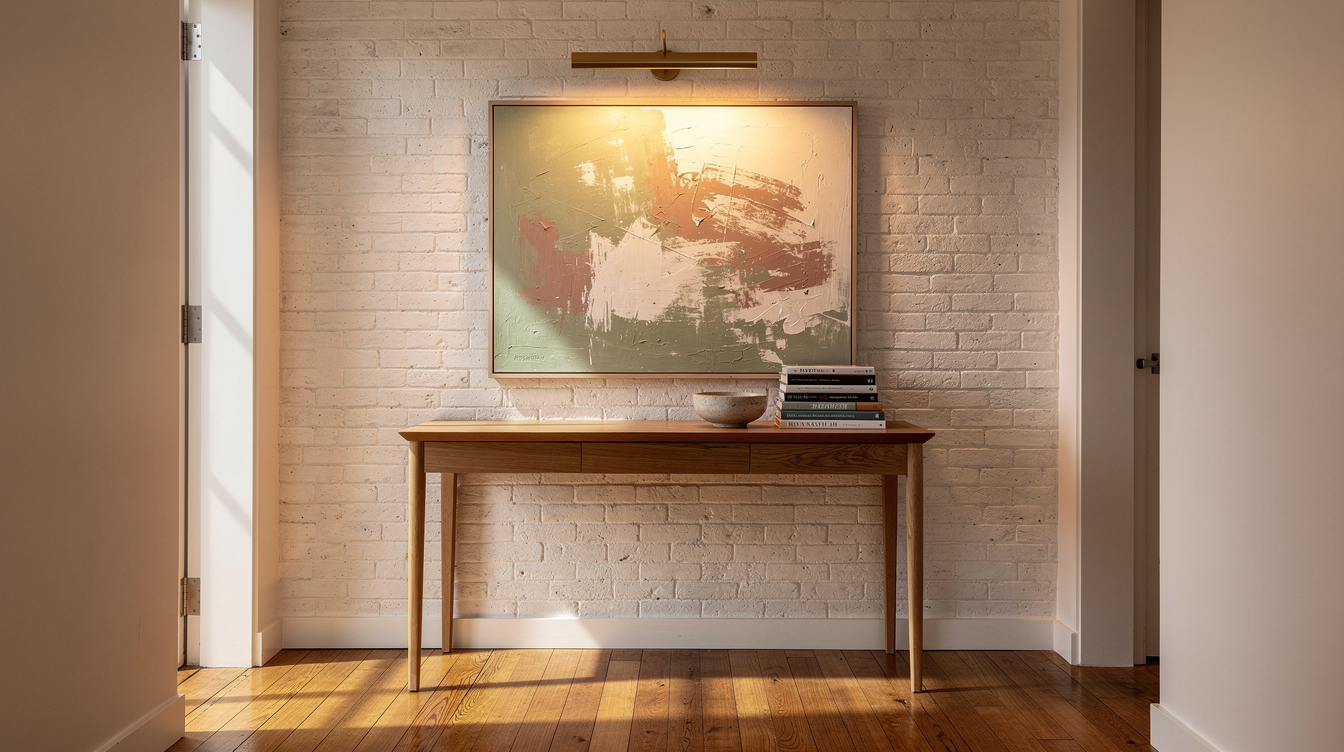
LED lighting with a high colour rendering index (CRI of 90 or above) has become the standard for art lovers. Choose a colour temperature between 2700K and 3000K for a warm, inviting atmosphere, or go up to 3500K if your artwork has cooler tones. The difference is subtle but enormous: with the right light, you see every paint layer, every texture variation.
Angle matters too. Aim your light at roughly 30 degrees onto the canvas — this minimises reflection and adds depth. Museums use this exact technique, and you can replicate it at home with a simple track light or picture light.
Dimming Is the New Decorating
One of the strongest lighting trends I'm seeing in 2026: dimmable art lighting. The concept is beautifully simple. Same room, same artwork, but a completely different atmosphere just by adjusting the intensity. During the day, let natural light do its work. In the evening, dim a spotlight to just enough to softly illuminate the piece — it becomes a kind of night light for your soul.
Scandinavian design has embraced this for years, and it's now firmly taking hold in contemporary interiors everywhere. Combine it with the organic, sculptural lighting trends of the moment — think blown-glass fixtures, warm brass accents — and your lighting becomes a work of art beside your artwork.
Let Light and Art Work Together
My advice? Experiment. Move a painting to a different wall and see what the light does with it. Try a dimmable spot. Notice how the April morning light falls into your living room and gives your art a new face.
Art isn't static, and neither is your home. The most beautiful thing about an original painting is that it moves with the light — and therefore with your day, your season, your life.
Curious how light could transform your favourite DNH piece? Browse the collection and discover which work your space deserves.