
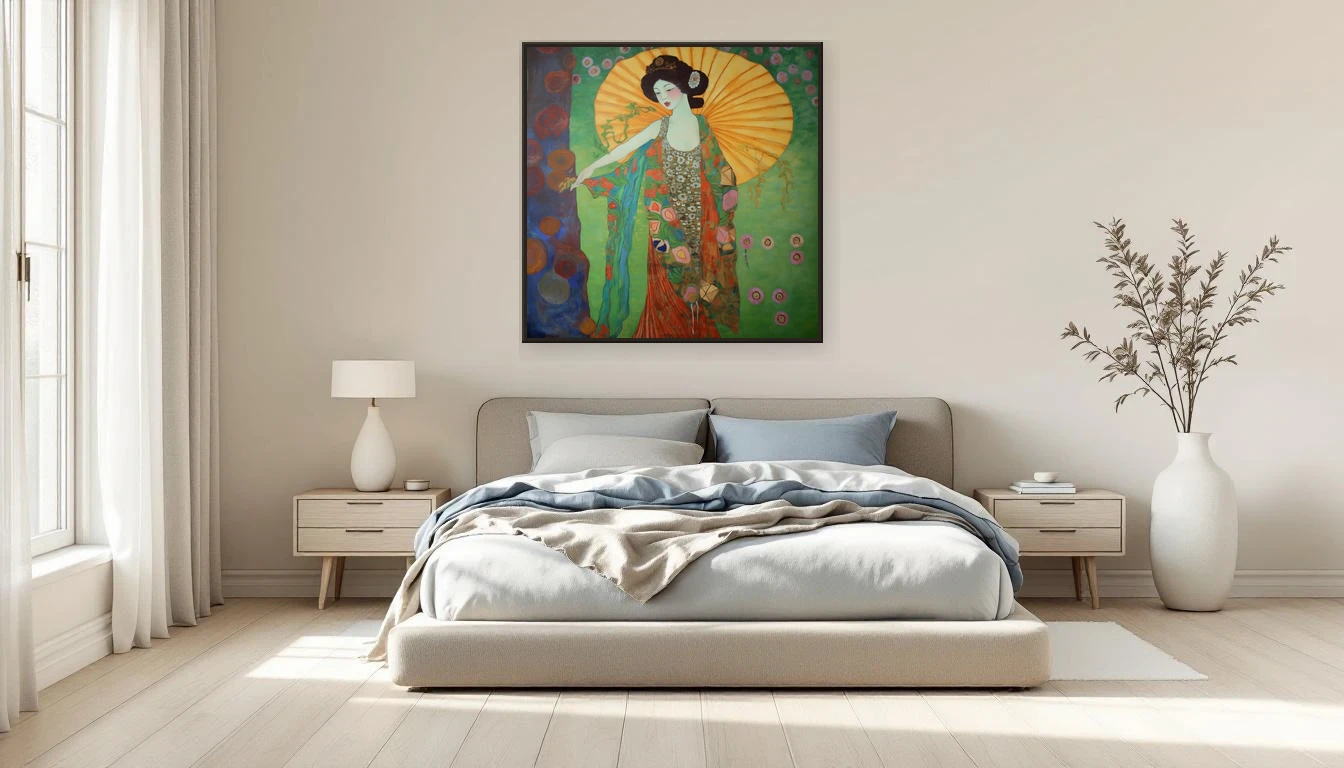
Something has shifted in the way we think about our bedrooms. For years, it was the room you fell into late and left early. In 2026, it becomes a real sanctuary — a place to come home to, not just to sleep in. Walking around my studio and thinking about the walls of my clients, I notice something striking: this is the room that quietly asks for art. Not loud, not statement-making, but present. Like a good friend who knows when to stay silent.
The bedroom turns into a sanctuary
Interior stylists are calling 2026 the year of the grounded sanctuary. The bedroom is getting a new role: not the place where your day ends, but the place where you find yourself again. That means waving goodbye to cold greys and hard edges, and welcoming warm taupes, clay-toned beiges, soft caramel and chalky off-whites. Dulux picked an indigo-leaning blue as its 2026 Colour of the Year — specifically for bedrooms, because it literally slows the heartbeat.
In my own bedroom I've been experimenting with this shift for months. I stripped the grey wallpaper off and had one wall painted in a soft clay tone. The difference wasn't visible — it was felt. As if the room had suddenly started breathing.
Why art above your bed does more than you think
We often say art belongs in the living room, where guests gather. But the bedroom might be the most honest place to hang a piece. No one is watching. No one is judging. It's your quiet dialogue — every morning, every evening.
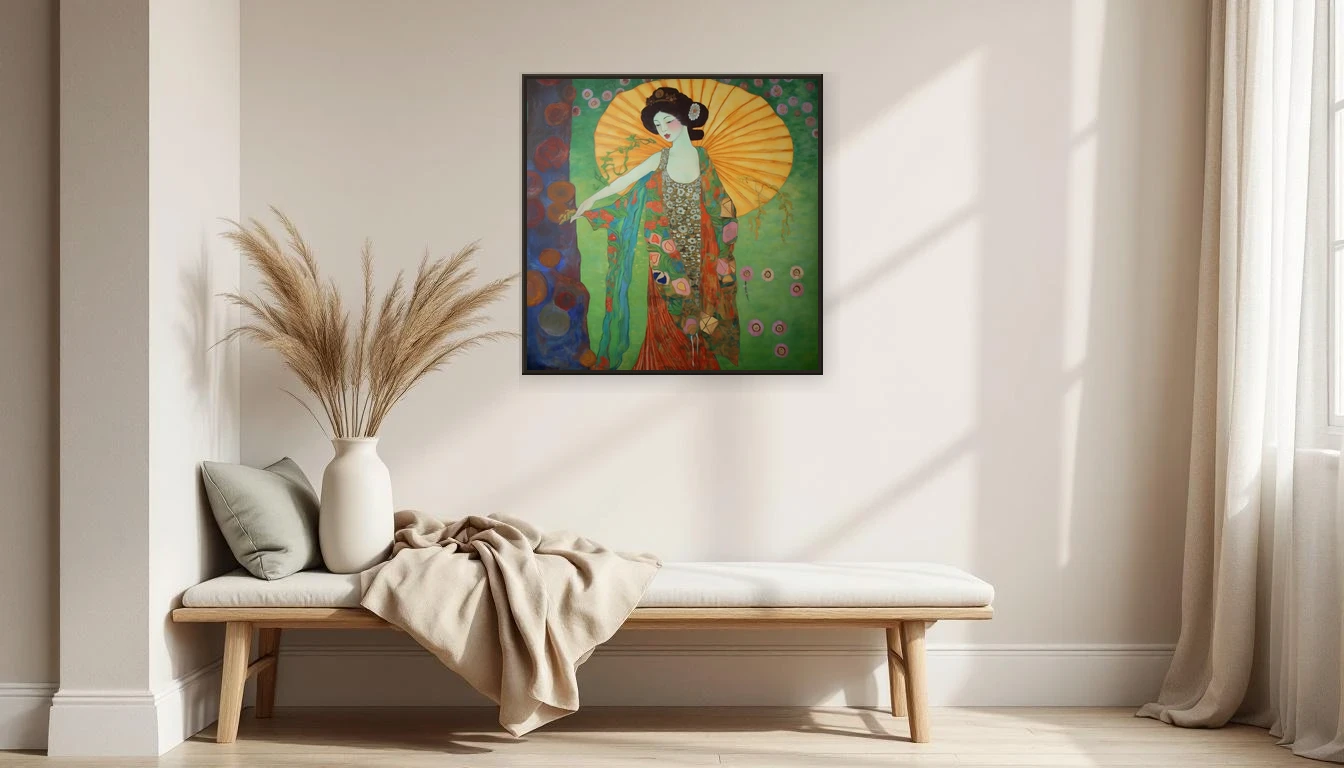
Neuropsychological research shows that the images you see right before sleep influence how your night unfolds. A painting with soft, natural shapes calms the nervous system. An abstract piece without sharp lines gives your brain something to relax into, not something to puzzle over. That's exactly what you want in a room whose whole purpose is rest.
Which piece belongs above your bed?
Pick art that fits the function of the space. A bedroom isn't a shop window — it's a breathing room. Usually that means: one calm piece, large enough to hold its own, but without shouting colours. Works in earth tones, soft blues or muted cream tones slot perfectly into the 2026 mood.
Think abstract landscapes, flowing lines, organic shapes. Avoid portraits that stare back at you — unconsciously, they keep you alert. Avoid hard black-and-white contrasts too, which pull the eye wide awake. My own Klimt Abstractie, for example, breathes exactly this kind of atmosphere: warm yellow and olive-green layers your eye can sink into without anything demanding attention.
Practical: how do you hang it?
The golden rule is simple: the bottom edge of the piece sits about 15 to 25 centimetres above your headboard. Any higher and it floats. Any lower and it feels pushy. For size: aim for roughly two-thirds the width of your bed. A 160 cm double bed pairs well with a piece around 100–110 cm wide.
And one more thing: don't let your bedroom become a gallery wall. One large piece always beats five small ones. The calm you're looking for lives in the simplicity.
A room to come home to
The 2026 bedroom is warm, soft, personal — and hung with nothing. Or really: with a single well-chosen piece that watches over every morning and closes every evening with you. That's how you stop building a bedroom and start building a sanctuary.
Browse my Originals collection for works suited to quiet, breathing rooms. Or get in touch if you'd like help finding the right piece for your bedroom — I love thinking along.