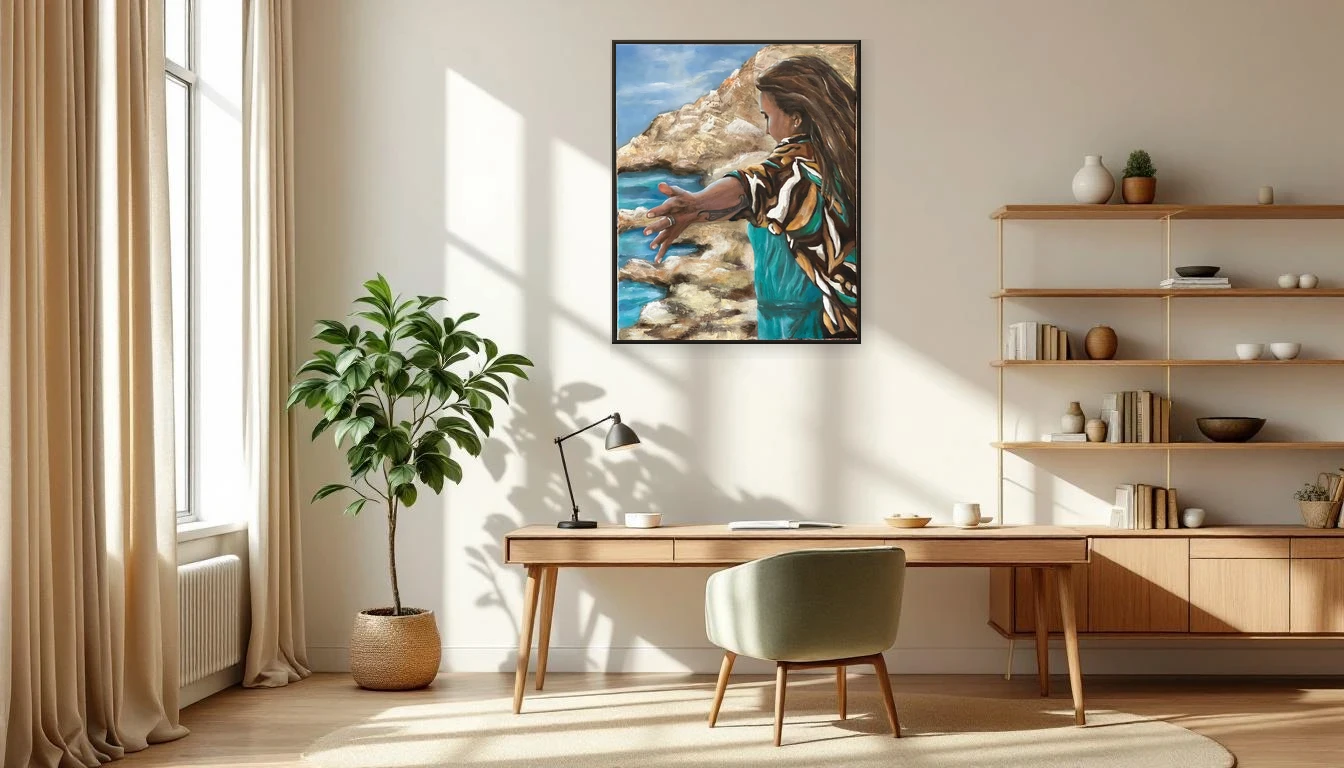
The other day I was on a video call from my studio when someone interrupted the meeting to ask about the painting behind me. I smiled — that canvas isn't there for the camera. It's there for me. But it made me wonder: how many of us spend our working hours facing a blank wall?
The wall you ignore is working against you
We've invested in standing desks, noise-cancelling headphones, and faster broadband. But the wall next to our screen? Still empty. That's a missed opportunity. Research from the University of Exeter found that people who work in spaces enriched with art and plants are up to 32% more productive. The same study measured 45% higher wellbeing and 60% greater engagement. The surface you stare at for eight hours a day genuinely matters.
Why abstract art belongs in a workspace
Abstract art does something unique in a work setting: it offers your eyes somewhere beautiful to rest without pulling your mind into a story. A figurative painting demands interpretation — your brain tries to decode the narrative, which costs cognitive energy. Abstract forms and colours work differently. They engage your visual cortex without hijacking your conscious attention. It's like giving your mind a micro-break while your eyes land on something alive.
Choosing the right piece for your workspace
Not every artwork suits every desk. Here are a few principles I share when clients ask for advice:
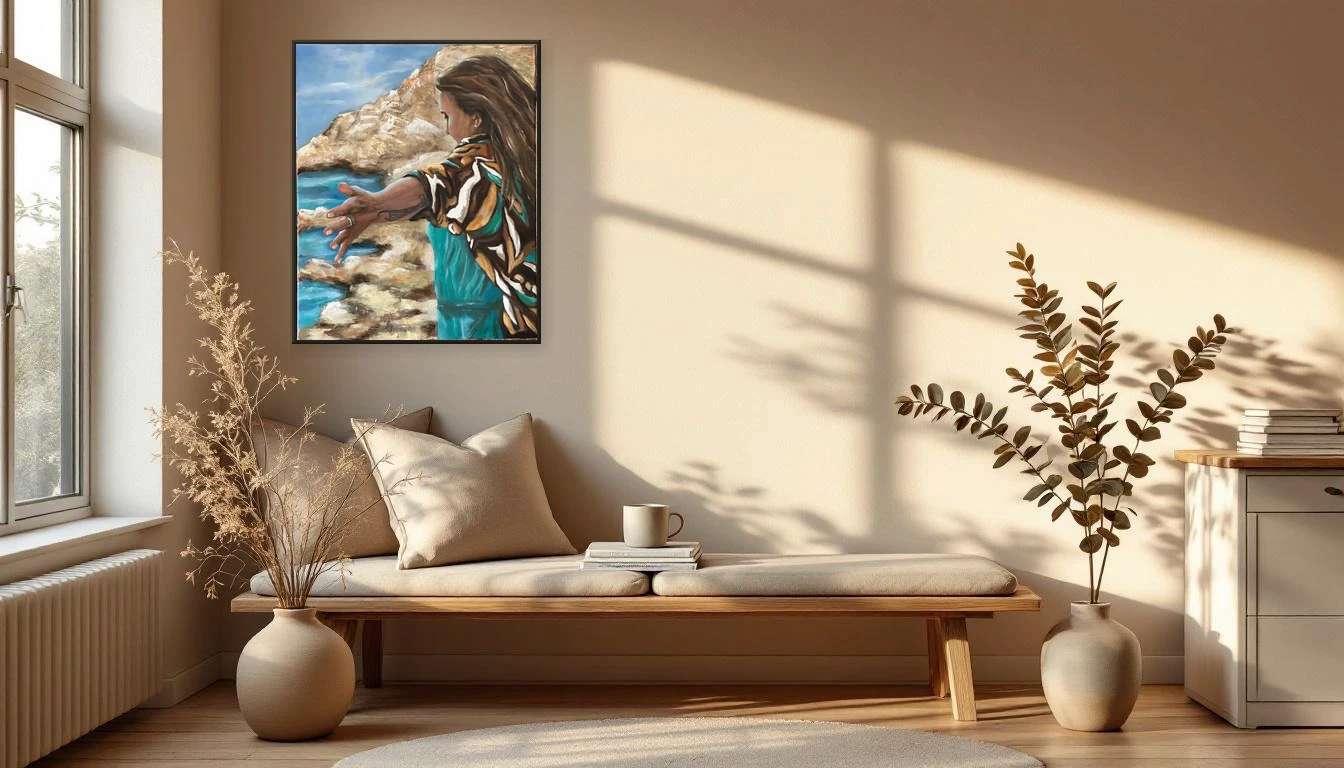
Let colour follow feeling. Soft earth tones — olive green, warm sand, muted blues — support concentration and calm. This aligns beautifully with the biophilic design movement dominating 2026 interiors, where natural palettes and sensory richness take centre stage. Brighter accents work well if you're looking for creative spark rather than deep focus.
Think bigger than you'd expect. A small 30x30cm piece disappears next to a monitor. Go larger — an 80x100cm work gives your wall real presence and draws your gaze away from the screen, which is exactly what you need during a thinking pause.
Texture brings warmth. One of the strongest trends this year is tactile art: visible brushstrokes, thick layers of paint, mixed media surfaces. In a workspace where everything is flat and digital, a physical artwork reintroduces the sensory depth that no screen can offer.
Art as a daily reset
I notice it myself in my studio: the moments I hit a wall — with a design, an idea, an email that won't come together — I look up. My eyes find a canvas. I follow the lines, the colours, the texture. Ten seconds, that's all it takes. And then there's space again.
That's what art does in a workspace. It's not decoration. It's not a video-call backdrop. It's a daily reset — a visual anchor that pulls your brain out of task mode and brings it back to the present moment.
An investment in yourself
The British Council for Offices found that 78% of employees say artwork reduces stress at work. But you don't need a study to feel it. Hang a piece that moves you — one that opens something up every time your eyes drift towards it. Not because it matches your desk, but because it matches you.
Curious which piece would work in your space? Browse the collection or get in touch for personal advice. I'd love to help you find it.